
Nothing II: Labyrinth
With one hand, we sweep across the console. Countless Dyson spheres flare aggressively as two galaxies are shifted billions of light-years by the gesture. But there is still one final mystery that gnaws at us.
At the center of the universe, at the point where all axes meet, lies a place riddled with black holes and quasars. We brush a hand across this pinprick, but while all surrounding matter can be smeared aside, this primal force remains unchanged.
The labyrinth of gravity and high-energy radiation resists Nothing. Nothing can survive there, nothing can pass through it.
But we are Nothing.
We have achieved everything. Created stars ourselves and unraveled the Big Bang. Realized that it did not spew forth all matter. Matter emerged from Nothing. It was simply there, just like the laws of physics.
The laws we now circumvent.
Determined to uncover this final secret as well, we close our eyes.
And open them again at −270 degrees Celsius, in the “vicinity” of the immutable place.
Cold cannot harm us, no more than radiation or vacuum. We widen our eyes and move the space around us at incredible speed.
Gravity strong enough to imprison even light can find no hold on us. The network of black holes is impenetrable, greedily devouring anything else and crushing it within a trap of almost infinitely slowed time.
The deadliest object in the universe, a quasar, unleashes a beam of light. As much energy as a sun produces over its entire lifetime, released within minutes.
The blast strikes us with its full force.
Plasma trillions of degrees hot, and yet nothing happens to us.
Nothing …
We are immortal.
Indestructible.
We are eternal.
We approach the absolute center. The labyrinth of deadly radiation lies behind us. There was no proper path through it. It could only be overcome by smashing through every obstacle with overwhelming force.
At the heart of the universe, something floats. Barely larger than a meteorite. A kind of tiny planet. White and small as a pearl, surrounded by the shell of space itself.
The oyster of existence.
It would take only a few minutes to walk around this pearlescent celestial body. A sphere flies through the atmosphere, tracing its orbit. An artificial sun that provides light and simulates day.
On the opposite side follows a satellite. The moon of this planet, representing night.
We land on the surface, made from a material unknown even to us. Sterile white, as though it were a germ-free laboratory. So unnaturally white that the ground begins to glow whenever the miniature sun passes overhead.
Beneath the satellite, however, the ground transforms into transparent glass, offering a view into a seemingly infinite core. No iron core turning and generating a magnetic field, as on Earth.
As far as we can tell, this phenomenon of mass is hollow and should, by all rights, collapse beneath its own weight.
Not a single tree, shrub or even blade of grass grows in this place.
As we walk across the ground and feel the material beneath our feet, it is hot and cold at once. Hard and soft. Sharp and blunt.
Nearly every property imaginable.
But all at the same time.
It is impossible to settle on a single sensation.
Step by step, our feet carry us across this pearl, searching for a cave, a structure or any geographical irregularity.
Just before we are ready to give up and abandon the attempt, a pillar rises beyond the next curve. We have crossed this spot several times already, we are certain of it, and there had been nothing there before.
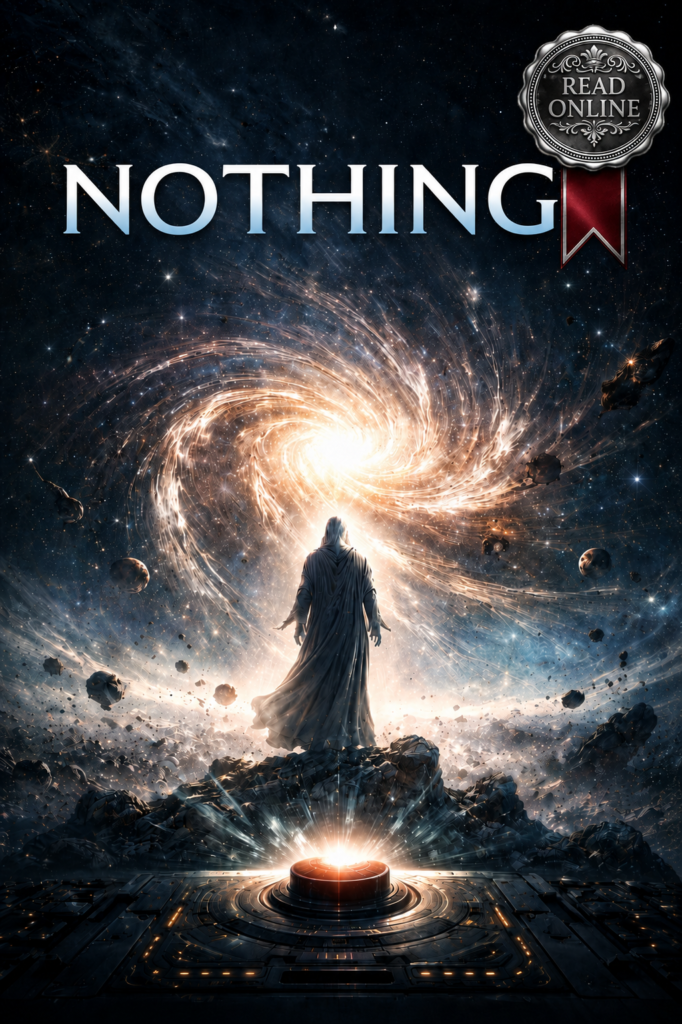
Now there is a pedestal.
Made from the same material as the planet itself.
Set into the pedestal is a red button.
It looks as out of place as a Kadmuntan veil whale at a tea party.
We inhale the vacuum and pause.
In clean, pulsing letters, written in our native language, are the words:
“Please press!”
We are confused, because we have never been to this place. How could this writing have appeared on the pedestal?
Millions of years have passed since the Union, and our ancestors did not possess the technology to break through the labyrinth and reach this pearl by conventional means.
In vain, we try to see through the button. To nothingify it, just as we alter everything else.
But it slips beyond our will.
Annoyed, we press the button.
And wait.