

Genre: Philosophical Science Fiction / Dystopia
Target Audience: Teens & Adults
Status: Complete
Published: 3 Chapters
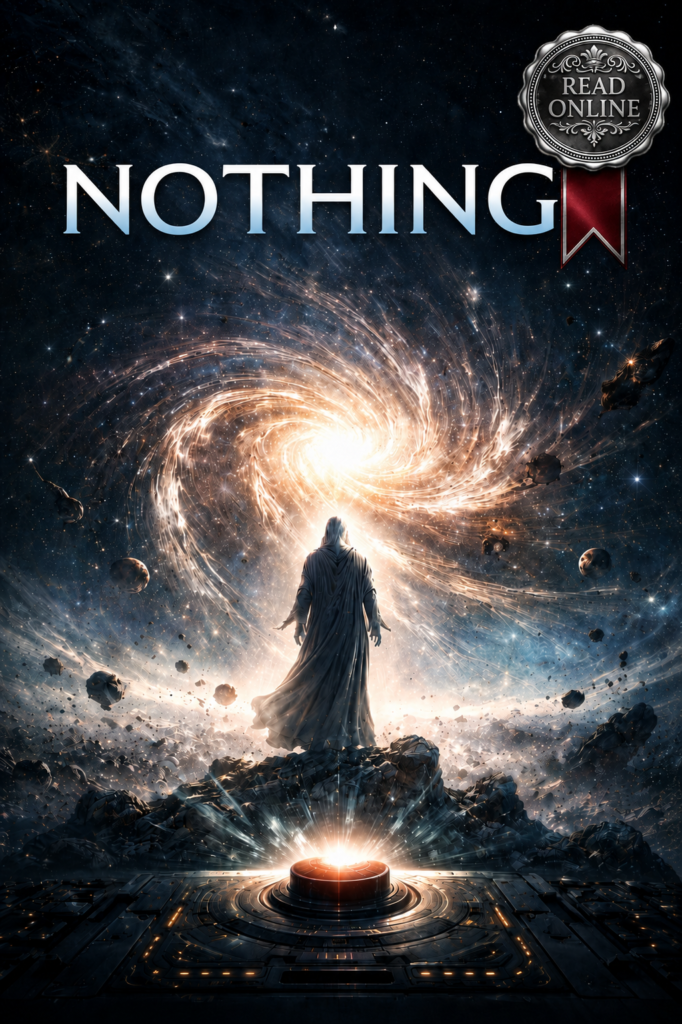
At the center of the universe, the final secret of existence awaits.
The most powerful being in creation embarks on a journey that calls into question everything that is — and everything that ever was.
At the end lies a truth powerful enough to shake reality itself.
Reading Time: approx. 15 minutes
Nothing I: Art and Culture
We gaze into the darkness. Surrounded by a static frame, it is not the emptiness that touches us, but the roughly one trillion copper atoms at its center. No larger than a speck of dust, they form a photorealistic image of the sun of Tetra 232.
Shaping this pattern took us approximately one thousand years of painstaking work. Each copper atom, in turn, consists of exactly 190 quarks. In nature, the number varies, but for this work of art, we selected every single atom according to strict criteria.
These quarks are arranged to resemble the spiral galaxy of our home system. Bringing the 1.9 quadrillion tiniest particles into position took us roughly 100,000 years.
But what truly moves us, what reaches us deep within, are the Squeezes from which the quarks are made. The image of a rainy day on the mother planet. A Squeeze is so infinitely small that detecting one requires a particle accelerator the size of a standard solar system.
A quark consists of 366 Squeezes, and the final arrangement of these more than 695 quadrillion particles took another million years.
And every single second was worth it.
What is smaller than a Squeeze?
A realization that remained hidden from us for a long time, and whose discovery demanded enormous effort even from us.
Once one investigates the structure of a Squeeze, one arrives at the following conclusion:
There is nothing.
At the very foundation of its existence, everything consists of nothing.
And nothing is everything!
Matter, once one looks deeply enough, no longer has any structure at all.
We swallow as we reflect on the brief creation of this singular masterpiece. By comparison, cataloguing life was a Sisyphean task, and in the end, it can never truly be completed.
From every plant, every animal and every microscopic life-form, we have preserved a specimen in stasis aboard the Ark. Powered by the energy of a Dyson sphere—the full power of an entire star—it lies safely guarded at the heart of the Empire.
Behind a defensive wall of plasma cannons and automated warships, no one can harm this collection.
From time to time, we bring some of our favorites out of stasis.
Bunga Bunga, for example.
Once an emerging species, they nearly destroyed themselves in a chain reaction of rage, hatred and ignorance. Nuclear war irradiated their home planet, and survival there is difficult.
And yet nature fought its way back. As did Bunga Bunga, who encountered us dressed in animal hides and armed with a club.
How his antics make us chuckle.
He must think us some kind of god, just as his ancestors did when we once visited them.
And yet we know: everything is nothing, and nothing is everything!
And nothing is faster than light!
To be aware that one is nothing—this profound understanding—allows one to override and circumvent every law of physics.
We close our eyes and open them again.
We are no longer before the image within the image within the image at the edge of the universe, but in another star system.
At the center of the Empire.
All known galaxies float as a hologram above a console. Blinking lights symbolize countless Dyson spheres. A guarantee of unlimited energy, always available.
Only systems without significant life are used for this purpose. Once a sun is enclosed by structures, everything dies from the cold.
Because light means life.
Green lights represent cultivated garden worlds. Planets on which we have introduced and multiplied life. At first, known species, but gradually creations of our own.
Red, dimly glowing lights mark rocky planets undergoing terraforming. Lava flows, frozen continents, insufficient or nonexistent magnetic fields and therefore no adequate protection from cosmic radiation.
To make these worlds useful to us and to other species, their properties are redefined.
Yellow marks quarantine planets. Worlds much like Bunga Bunga’s. They carry a certain danger: radioactive radiation, a swollen red giant nearby, or parasitic life-forms.
These planets are not dangerous to us, but to our wards.
That is the meaning of life to us.
To give life meaning.
To make the wasteland of space bloom green.
Because life means possibility.
Reproduction is another way of giving life meaning, but since our union, we no longer need this unnecessary waste of time.
We no longer have to adapt ourselves to the environment.
We are perfect.
And yet, after nearly 250 million years of existence, a certain resignation begins to spread.