
Why Is It Becoming Harder for Us to Say No?
“No is the fundamental word used to express negation and rejection in the German language. It serves as a direct negative answer to a question or expresses contradiction, refusal, and prohibition.”
Wikipedia
For modern parents, it is important that their child is able to say no. After all, learning to say no also means learning to set boundaries and to assert one’s own needs in relation to others. Those boundaries are meant to be expressed with confidence and self-determination.
So we read books such as The NOhorn and attend “Say No!” courses, where role-playing involves a great deal of loud shouting.
Things that people once simply endured without question, like Grandma’s kisses or having their cheeks pinched, are now met with: No!
Going to bed? No!
Rules? No!
Rejection becomes deeply ingrained. And yet, at some point, there comes a quiet, almost imperceptible transition. And the word no begins to disappear from our vocabulary.
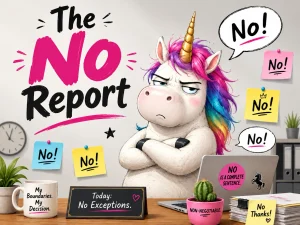
Saying No at Work – Why Boundaries Are So Important in the Workplace
At work, boundaries are no longer being drawn, and self-confidence begins to fade.
Instead, we cling to the job that feels secure, even if it makes us ill and pushes us a little closer to depression every day through sheer monotony.
Having mentally quit years ago, we drag ourselves in to work alongside colleagues who cannot stand us. We clock unpaid overtime even when no one has asked us to do it. Because that is simply what is expected.
Say no? Not a chance.
There is hardly any free time left; constant availability has long since blurred it into the working day. Just answer one quick email, and that PowerPoint presentation is still not finished either.
Saying no feels improper. You might attract the wrong kind of attention.

But the No Report goes on: customers, clients, and guests are all too willing to treat people with contempt, enjoy their position of power, and take out their pent-up anger on others. And it all has to be endured with a smile. Because the customer is king, and the customer does not take no for an answer.
It is the brave face we put on in a bad situation, and little by little it eats away at us. Day by day, it makes a part of us die a little more. According to the RKI, around 10.1% of people in Germany showed symptoms of depression in 2014/15. By 2025, that figure had risen to roughly 22%. Alarming numbers.
Even when we are ill, we would rather drag ourselves into work than take the time to recover. Covid taught us nothing. Productivity has to be maintained. Because we see ourselves as indispensable: “I can’t be sick, I have to work” is a phrase that captures it all too well.
Why Do People Stay in Unhealthy Relationships?
Relationships are actually something beautiful, as long as they do not become toxic.
Out of habit, people stay in them until the very last possible moment. Doesn’t everyone know at least one couple who are only still together because finding a new partner would take effort?
Even when boundaries are crossed, it can be difficult to admit what is happening. Unable to draw the line and say no.
Whether the perpetrator is a man or a woman makes no difference. Appearances have to be maintained, even if the first person being lied to is oneself.

Why Is It So Hard for Us to Say No to Consumption?
Temptations are everywhere today.
The Heart Attack Burger with thousands of calories, bringing us a little closer to a heart attack with every bite. Add to that a composition of the sweetest dessert with cream, caramel sauce, and chocolate sauce.
Saying no to flavour enhancers and colourings is almost impossible. And the official obesity figures are rising. From 12.2% in 2003 to 19.7% in 2023.

Likewise, we want to consume.
Over-the-top advertisements make the latest smartphone look irresistible, even if the old one is barely a year old. With the right contract, it supposedly costs 0 euros anyway, even if three separate contracts are already running.
Klarna and Smava quickly make it easy to forget how much debt we actually have. Life is paid off in instalments that gradually take away more and more of our financial freedom.
And now comes an actual surprise in the No Report: despite inflation, the official over-indebtedness rate among people under 30 fell from 15.37% in 2014 to 6.95% in 2025.
Credit where it is due: we are no longer living quite so far beyond our means.
General indebtedness, however, has risen from 13% to 20%. So we are saying yes to new things more quickly and more impulsively.
The smartphone also wears down our resistance. Every push notification, every vibration creates FOMO: the fear of missing out. We cannot help ourselves; it feels almost like an addiction.
The dopamine hit is simply too satisfying. Since 2014, average daily smartphone use has increased by around 30 minutes to almost four hours. So we spend less and less time in the here and now, preferring instead to scroll through Instagram and watch interesting short clips.
Why Companies Say No Too Late
According to the No Report, companies too are often unable to stand up for their own interests.
The insolvency rate is now similarly high to the period following the 2011 debt crisis, after six years marked by economic mismanagement, lockdowns, and excessively high energy prices. Back then, however, it was a European phenomenon with global consequences, whereas today the problem affects Germany more specifically.
Because the economy tends to react with a delay, we may still be facing a harsh awakening. In 2014, there were 24,085 corporate insolvencies, compared with 24,064 in 2025. In other words, almost exactly the same.
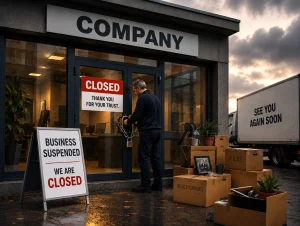
What makes me sad is the quiet decline. Companies would rather cut costs through shrinking package sizes or cheaper ingredients than loudly draw attention to the problems.
Even major chains are moving abroad in search of lower costs.
Organize and take to the streets? Better not.
Conclusion: How Can We Learn to Set Boundaries Again?
So why is it becoming harder for us to say no? Why do we give in to so many temptations? And why, at the same time, is it so important to us that our children become better at resisting them?
Because our minds are colliding with a highly refined industry, and deep down we are well aware of that weakness.
It is like my mother and smoking: she knew it was poisoning her body and that it was an addiction, but she could not stop.
Still, it was important to her to teach me: stay away from it, it is stupid. Only when cancer became a reality was she able to find the determination to quit. The consequences had caught up with her.
In the same way, many people should be aware that stress at work is harming them. Or sugary food. Or smartphone use. Or debts and contracts.
But because the effects creep in gradually, that makes them all the more insidious.
Impressions are constantly raining down on us from every direction. Most of them perfected down to the smallest detail, constantly wearing away at our willpower.
So often and in such quantities that resisting them can seem almost impossible. Psychologists understand our weaknesses, and industries make use of that knowledge.
So let us try to remain more consistent. Let us stay self-determined and set boundaries.
One weak moment is no reason to give in completely again.
Stay strong, even when it is difficult. We all have far more willpower than we think. Once we find our flow, the momentum can carry us forward.
I hope you enjoyed the No Report.
See you in the next one.
Yours,
Ted Dybaer
Did you enjoy the blog?
⭐ Follow me on Instagram & Facebook
☕ If you would like to support my work, you can do so
on BuyMeACoffee, Patreon, or via PayPal
You can discover more stories, worlds, and thoughts here: