

Overtreatment in medicine is the subject of this article: procedures that can be a blessing, yet sometimes blur the line toward Frankenstein. It is also about treatments that allow us to avoid working on our own mistakes, because medication and surgery can solve our problems for us. But to what extent do these methods stand in the way of our true selves?
1. How Far Should Medicine Go? From Neanderthals to Frankenstein
The history of surgery is a long one: trepanation was already being performed in the Stone Age, meaning the skull was opened, for example, to remove a tumour. What was once associated with enormous pain was revolutionized on October 16, 1846. Dentist William T. G. Morton placed a patient under ether anaesthesia so that a tumour could be surgically removed.
Procedures continued to be refined and improved until, in 1967, a human heart was transplanted for the first time. In 2015, Sergio Canavero announced his intention to carry out the first head transplant: surgically removing the head of a patient with a severely limited life expectancy and transferring it onto the body of a brain-dead donor.

However, the procedure never took place. It was too ethically controversial, financial support collapsed, and the volunteer withdrew. After all, every experimental animal used beforehand had died within a few days, and reconnecting the spinal cord had so far only been achieved under laboratory conditions.
There is another question as well: if even patients with a single donor organ sometimes report new memories or changes in personality, what happens when only the head is still truly mine? After all, the self does not arise from the brain alone. It also emerges through the liver, heart, gut, and the totality of all our cells.
And what if an entire immune system is working against me? Rejecting me bit by bit? How long would a body function without the brain it developed with? The two grew together and are finely tuned to one another. Hormones. Nerve activity. All of it varies enormously from one person to another.
It is not like getting into a different car and finding everything exactly where it should be. Maybe the accelerator is in the trunk, the car runs on only three wheels, the air conditioning activates the indicator, or the driver’s seat is upside down. What looks the same from the outside is, in reality, highly individual and unique.
2. Medical Overtreatment: The Blessing and Curse of Surgery
Modern medicine is capable of remarkable things: I once heard about a child who stepped on a landmine. The explosion destroyed the lower leg beyond the knee, making amputation necessary. The ankle joint, however, was still intact and was surgically rotated and attached to the thigh in reverse. This procedure is known as a Van Nes rotationplasty.
What sounds like a bad April Fool’s joke can actually make a prosthesis far more stable. The more of the body’s own joints can be preserved, the safer and more natural the gait can become.
Medicine improved this child’s life, but such successes may also encourage surgeons to see patients more and more like malleable figures – as if something merely has to be removed, rearranged, or cut differently in order to optimize the person.
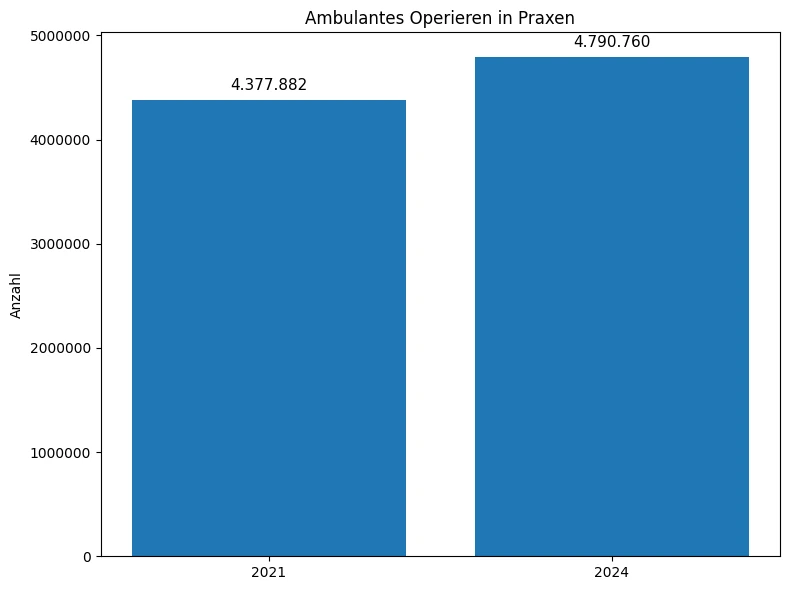
Inpatient operations increased by 34% between 2005 and 2024. One example is knee replacements, which rose by 93%. Outpatient procedures performed in hospitals increased by as much as 60%. On top of that, there were 4,790,760 outpatient procedures carried out in private medical practices, representing an increase of 9.4% in just three years.


Our healthcare system reimburses procedures and examinations performed on patients, but offers little financial incentive for actually making them well. As a result, more operations are performed, because they generate the greatest revenue. The fact that hospitals and medical practices have to operate economically is, above all, one of the biggest perverse incentives.
I ask my patients: Is the operation really necessary? Have conservative treatment options genuinely been exhausted? Is the pain severely limiting my everyday life, or is it still manageable?
Of course, surgery can lead to the desired outcome, but it can just as easily treat the wrong cause. In the worst case, it may result in excessive scar tissue, infections, nerve damage, organ damage, or even death. Even routine procedures carry a residual risk.
And we should always keep that in mind.
3. Self-Optimization Through Medicine – From Desire to Ideal
After the malleable human comes the homunculus. Because modern medicine seems to have an expensive pharmaceutical solution ready for every problem.
Obesity and severe excess weight have been major issues in industrialized countries for decades. In a society of abundance, people no longer have to go hungry, and temptation is everywhere.
This is how the body positivity movement emerged. Originally intended to encourage people to accept themselves as they are – with all their flaws, which is absolutely right – it has increasingly been used as an excuse not to address even extreme and unhealthy obesity.
The status quo becomes acceptable.
Until the shortcut appears.
Ozempic injections or Wegovy tablets make the dream body possible – the one people may have secretly wanted for years but thought was out of reach. No one has to stay overweight anymore. No hunger, discipline, exercise, or calorie counting required.
The pounds can melt away in record time. But they may return just as quickly once the medication is stopped. Eating habits have not changed in a lasting way, and the result was not earned through a change in behaviour.
These shortcuts can prevent the potential transformation of my personality. I do not need to learn how to cook healthy food and discover that I actually enjoy it, because I can keep eating at the snack bar. I do not need to exercise and learn that movement can release feelings of happiness, because the new knee joint takes away the pain.
Potential remains unused, and we stay inside our comfort zone.
4. Conclusion: When Does Overtreatment in Medicine Become a Problem?
I could give many more examples of medicine going too far: from medication for bedwetting and cosmetic surgery to gender-affirming surgery.
It is remarkable what procedures we are willing to endure – and how readily we sometimes move toward ever more radical measures – before accepting ourselves as we are.
Perhaps we should stop seeing a flaw as a weakness or a stigma, and start seeing it as an opportunity.
Like a friend of mine who lost most of his eyesight while still young. Against all odds, he became a physiotherapist, then an osteopath, and is now self-employed. Of course, he relied on specialist training centres for visually impaired people as well as support from friends and family.
I do not know whether he would have followed the same path if he had been able to see. Hardship and limitation may have helped reveal potential within him. In an alternative universe, perhaps he would simply be another ordinary guy playing Call of Duty and working a boring office job.
What does not burn in the fire becomes hardened by it.
Willpower does not develop when every problem is removed from our path. It develops through the difficult road. Through going the extra mile.
Self-acceptance cannot grow if everything around me keeps telling me that I should change something about myself – while surgeons offer me the means to do exactly that.
Life is not a character editor, and our values are not interchangeable.
We are not lumps of clay to be reshaped at will, even if turning a foot into a knee can sometimes provide greater stability. 😉
See you in the next one.
Yours,
Ted Dybaer!
Did you enjoy the blog?
⭐ Follow me on Instagram & Facebook
☕ If you would like to support my work, you can do so
on BuyMeACoffee, Patreon, or via PayPal
You can discover more stories, worlds, and thoughts here: