How Does a Story Come to Life? My Writing Process
Before we move on to the more serious topics, my first article offers something a little lighter. It is about why I write, what my writing process looks like, and what ultimately turns an idea into a story.
The scratching of a pencil across paper or the tapping of keys on a laptop – both are incredibly satisfying sounds to me. Like music. A symphony of its own, sometimes building with intensity, then giving way again to gentler passages.
And then there are the blank pages, slowly filling with graphite and letters – like fresh shoots in spring, delicately reaching their buds towards the sun as they begin to grow.
First of all comes brainstorming. Ideas are gathered, visualized, and discarded again – a magical process, because nothing is fixed yet. There are no boundaries or restrictions. Everything is constantly changing through pure creativity.
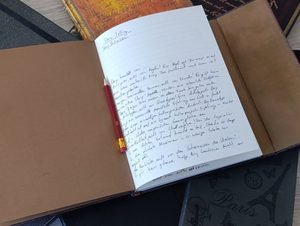
If the idea still refuses to let go of me after some time, I start writing in pencil in a Paperblanks notebook, often one with a beautiful cover and hundreds of empty pages. To me, this kind of writing is the very definition of craftsmanship: paper, hand, and mind are connected, constantly exchanging ideas with one another.
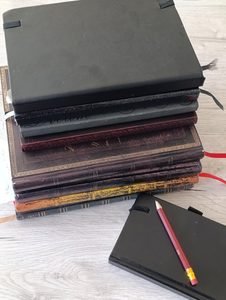
It is also a kind of therapy, because once I have written something down, it no longer clogs up my synapses. It creates space for something new – and that, too, is one of the reasons why I write.
The rough draft usually reads rather clumsily and stiffly. I then transfer it to my laptop and revise it for the first time straight away. A great deal can still change – the story is not static; it is constantly evolving.
This is often where an interesting process begins: the characters and the plot start to take on a life of their own. Unexpected things happen that I never planned for. That is the moment when the story develops a heartbeat and begins to breathe.
After countless revisions, the story eventually finds its final form. In truth, it is never really finished – there is always something you could change: a phrase that bothers you, or a passage that does not quite flow when spoken aloud.
But at some point, the ink has to dry, and the story has to be considered good enough.
How Did It All Begin? My Journey into Writing
I never had any particular affinity for books when I was younger. I remember a reading competition in primary school. I had not practised, so naturally I stumbled over my words and kept getting tangled up.
Even so, there was a period in secondary school when I spent my breaks writing a detective story – simply out of boredom. My classmate Martin and I solved cases together, and it was fun. Eventually, though, other things became more interesting.
Later, I wrote two pages about a game called Nox. Mages, warriors and conjurers struggle for dominance in their world, while necromancers grow stronger in the background and threaten the peace.
At seventeen, during a youth trip to France, I started what we called the “Frog Book” out of boredom on the coach. Many of the boys contributed chapters. I would rather not write about the content here, because teenage boys do not exactly produce much of lasting value.
Up to that point, it had all been for fun and without any real system. It happened spontaneously, directly with a pen in my hand.
Then, around 2016, something strange happened. On the bus ride home from work, I started thinking about which element, in classic superhero fashion, would be the strongest and which would be the weakest. I came to the conclusion that air was almost overpowered. It is everywhere, I could take it away, and I could summon hurricanes. Water, on the other hand, seemed like the most challenging element – heavy and cumbersome, because you always have to carry it with you. But when used properly, it has incredible potential.
The thoughts kept circling more and more. Characters began to take shape, factions emerged. My fascination with Greek mythology flowed into it, and eventually a modern odyssey in a dystopian setting began to form. In that world, magic and science are difficult to tell apart, very much in the spirit of Arthur C. Clarke: “Any sufficiently advanced technology is indistinguishable from magic.”
By then, two years had passed. It had grown into an exciting story with so much material that I had to make a decision: either do something with it and start writing, or put the whole idea to rest.
At first, I wanted to turn it into a computer game. But the barriers to getting something like that accepted seemed just as high as submitting a screenplay, and I had no experience with either. So the decision was made: it would become a book. After all, I can write – at least a little.
I bought a laptop and writing software, read up a bit on storytelling, and alongside my work as a physiotherapist, I became a writer – even though it took me a long time before I was willing to call myself one. It is a very German attitude: only once I have written something truly substantial am I allowed to use that title. Today, I know better.
The life of a writer, by the way, is often rather unspectacular and full of sacrifice, because almost everything happens inside your head – sparked by the words that eventually leave your hand.
In 2019, my first side project came into being. I wrote Efi the Mouse Girl for my niece and nephew and had a tiny print run of just three copies made.
A year later, I also wrote The Thorn Bear for the two of them as a writing exercise – a far more ambitious project, and one I am still very proud of.
From 2022 onward, I took a three-year break from writing. A lot happened in the real world. Covid had turned everything upside down and occupied a large part of my thoughts. There were also two deaths in the family, and my cat passed away as well. It was probably the lowest point of my life, marked by many setbacks – but there was also one bright spot: I met the woman who is now my wife.
At the end of 2025, I finally wrote another story, this time as an Advent gift for my boss: Manaby! I had no fixed idea of what it was supposed to become. That was something new for me. Before then, the process had always been long and laborious: first I would collect ideas over an extended period, and only then would I begin writing.
In 2026, I also wrote Nothing – a philosophical science-fiction story in which I really allowed myself to go wild.
What I love most about writing is the editing process. A spoken word can never truly be taken back once it has been said. A text, on the other hand, can be refined again and again – optimized, reshaped and perfected. If I do not like the ending, I rewrite it. I can keep shaping the story, turning every word over, until it feels right.
And that is exactly what I do. It also means that my stories tend to have bittersweet endings. Rarely a true happy ending, but rather something more realistic, with consequences. Because consequences matter to me. There has to be something at stake, otherwise you lose faith in the story and in the author. And trust is the most valuable thing of all.
Why I Publish My Stories
So why this website? Because I have to do something with the stories I create.
There is hardly anything worse than knowing that your own work could simply disappear – that the universes I have created might be forgotten once I am gone. And as a Stoic, I am very aware of how short a human life can be.
This website gives me an additional reason to put more energy into writing and to finally bring more of the stories that are still lying dormant in my mind to life.
Lenny the Salmon Swims Against the Current, The Magical Shoe, Sigrid the Dragon Slayer – there is still so much potential waiting to be explored.
I also want this website to entertain, because that is what good stories should do: make you forget the time, draw you into something new, and leave you inspired.
The blog is meant to be a medium for ideas, arguments, and thoughts – my contribution to humanity, so to speak, even if some of those thoughts may occasionally be controversial.
And why is so much of the content free? Because, in my view, the book market is enormously crowded. A great deal disappears into obscurity unless there is a substantial advertising budget behind it – and that is not where I see myself. At the same time, the economic situation is difficult for many people. Spending 20 or 30 euros on a book is no longer an easy decision for everyone.
That is why I am placing my trust in readers and voluntary support. I would rather have many people read my stories and contribute something if they want to than have only a handful of sales with higher royalties. The project is meant to grow steadily, and I hope that, in time, it will cover the costs of the website and provide enough funding for professional editing and illustrations as well.
I hope you appreciate the fact that, for me, this is a fairly bold step. The internet has always felt like a place of extremes: full of potential for wonderful things and great experiences, but also capable of unleashing enormous anger. A wave of hostility and an unexpected success can be only a few clicks apart, which is why I avoided putting myself out there for a long time.
But since my son was born in September, I have started to see things differently. I want to show him that you can work towards your dreams.
See you in the next one.
Yours,
Ted Dybaer
Did you enjoy the blog?
⭐ Follow me on Instagram & Facebook
☕ If you would like to support my work, you can do so
on BuyMeACoffee, Patreon, or via PayPal
You can discover more stories, worlds, and thoughts here: