


What follows is my theory on why children are falling further and further behind in their physical and cognitive abilities, while some stand out even though there is nothing particularly extraordinary about them, and a few seem to walk among us like demigods. But what really influences child development? It is the chains that hold us back and the wings that lift us up. And the unsettling part is this: it is up to us which tools we choose to help our children become an above-average average.
1. Why Does Child Development Vary So Much Despite Similar Starting Conditions?
Thought experiment: Identical twins are separated at birth. They have the same genetic starting conditions, and the only variable is the way they are engaged with in everyday life.
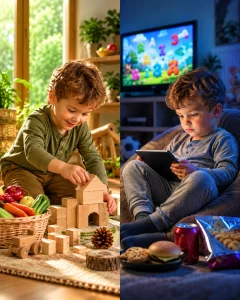
Child A grows up in a way that is appropriate to a child’s natural development. They build houses out of wooden toys and knock them down again. They play hide-and-seek with other children in the street and go for walks in the woods. Their diet is colourful and varied: fruit, vegetables, and occasionally fish and meat. No highly processed foods or sweets.
Child B grows up in a modern way. They play on a tablet and spend one or two hours a day in front of the television. Supposedly educational children’s programmes with giggling letters and numbers bouncing across the screen. The added value? Limited.
The child is underdeveloped in both motor and language skills and remains far below their potential. The same child, but with completely different outcomes because of a different everyday environment. And although the child growing up in a more natural way has no extraordinary abilities, in a society where more and more children are growing up in the modern way, they become an above-average average.
2. Are Language and Motor Skill Deficits Increasing Among Children?
The brain learns through experimentation. In the first weeks and months, babies initially explore their own bodies extensively with their mouths and tongues. A paediatric osteopathic therapist I know once explained to me that an area of the brain associated with the hand only develops properly once the hand has been thoroughly explored with the mouth.
Babies approach their surroundings in much the same way. Building blocks end up covered in saliva because every different surface is explored. Every taste is tested and classified as edible or not edible.
Putting a screen in front of a child, by contrast, exposes them to the same kinds of stimuli again and again. Perception and experimentation take place inside the device – a kind of Matrix light. Instead of throwing a cup off the table and experiencing gravity, colourful blocks fly across the screen. The child learns the physical rules of different games – but inside a computer.
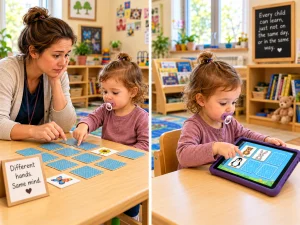
One example from a nursery teacher is particularly sad: she was playing Memory with a two-year-old girl. The child was not physically able to turn the cards over and could only point at them and wait for a reaction. Later, the teacher saw the same girl playing Memory on a tablet. She had understood the game, but she was only able to interact with it through the screen.
Children need to engage with their surroundings in order to learn in a lasting way. These same deficits can also be seen in motor skills: walking backwards, for example, is becoming increasingly difficult for many children. Something that should actually be completely ordinary. But muscles and brain can only coordinate properly if children are given enough opportunities to experiment and challenge themselves. Why would they, if they are simply parked in front of the television for hours?
The decline is real. Excess weight caused by poor nutrition only makes the problem worse.
3. What Role Do Individual Talents Play in Children’s Development?
Unfortunately, the proportion of children growing up this way is increasing. And this is precisely where children who grow up in a more natural, developmentally appropriate way can begin to stand out. They become above-average average.
You can already see it in schools. Good grades are being awarded to average students because many children are struggling with the basics. If that foundation is not secure, the progression of an entire cohort is at risk. Having half a year group repeat a grade? Not possible.
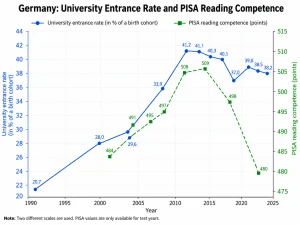
The number of students earning the Abitur makes this especially clear: in 1995, 27.7% of students graduated with the qualification, while in 2024 the figure was 38.2%. At the same time, students are performing increasingly poorly in PISA assessments. Reading performance reached a high of 509 points in 2016, but by 2022 it had fallen to just 480 points. Even training companies are criticising a lack of core skills among apprentices.
And then there are children who are genuinely gifted. Children with motor or cognitive abilities that clearly surpass those of others. In the past, they might simply have been labelled as nerds or overachievers; today, they stand out as exceptional talents.
The spectrum of abilities can become almost as varied as in Brave New World. There, people are divided into different castes: from the superior Alphas to the intellectually limited Epsilons.
4. Demigods – How Far Should We Go in Optimizing Children?
But above the above-average average stand the demigods: children optimized through modern procedures. Their intelligence, strength, and coordination stand out because the most advantageous genes have been activated. They are faster than Usain Bolt, stronger than Mitchell Hooper, and more intelligent than chess world champion Dommaraju Gukesh – all combined in a single person.
Some of these procedures are still partly fictional, and what is already technically possible is officially prohibited. But technology is advancing rapidly, and laws can change. Enough money can make many moral boundaries begin to erode.
Countries with such a population could therefore gain a decisive advantage – regardless of whether designing children is considered right or wrong.
5. Conclusion: What Do Children Need for Healthy Development?
So what should we do?
The good thing is that we as parents have it in our own hands whether we choose chains or wings. Raising a child in a developmentally appropriate way is not a question of money, but of attitude. Spending time with your child and teaching them something is not rocket science. Keeping them quiet with a screen is simply convenience.
That said, I do not want to demonize tablets completely, because the negative effects mainly arise from uncontrolled consumption. Even though the WHO considers up to one hour of screen time acceptable for children from the age of two, I take a stricter view: as little as possible and as late as possible. Ideally, none at all.
Even when it is difficult and all you want after a hard day is to switch off and be entertained, spending some time playing outside is good for everyone.
The Scandinavian countries in particular are already beginning to reverse course and return to schoolbooks instead of screens. Student performance has declined too much.
Good.
See you in the next one.
Yours,
Ted Dybaer!
Did you enjoy the blog?
⭐ Follow me on Instagram & Facebook
☕ If you would like to support my work, you can do so on BuyMeACoffee, Patreon, or via PayPal
You can discover more stories, worlds, and thoughts here: