The Line We Crossed – How AI Is Changing Our Perception
We are currently crossing the threshold into an Age of Doubt. The question of AI and truth is becoming increasingly important. Behind us lies the Information Age. Through the internet, people became connected and gained the ability to communicate and exchange ideas at any time of day or night. The result was a pace of human development unlike anything seen before.
Knowledge that had once been passed down orally for thousands of generations, and later preserved on paper, is now accessible to the wider public through platforms such as Wikipedia. Education is no longer a privilege reserved for a few, but has become a human right.
And yet, we may be the last generation able to trust our own eyes without hesitation. From now on, every image, every video, and every voice could be manipulated.
And the Age of Doubt has only just begun.
From Inflatable Tanks to Weapons of Mass Destruction – How Disinformation Works
There had, of course, been deception and lies before, but they required far more effort. Film sets, masks, and computer-generated effects consumed enormous amounts of money, even if ingenuity, talent, and manpower could compensate for a great deal.
During the Second World War, entire fake armies were staged as part of Operation Fortitude. Inflatable tanks and recordings of engine noises helped convince the Nazis that the invasion would not take place in Normandy, but around 250 kilometres away. In all likelihood, tens of thousands of soldiers on both sides were spared as a result.
Images of UFOs or alleged sightings of the Loch Ness Monster seem almost harmless in hindsight. Little more than jokes designed to attract some attention.
Fabricated evidence of weapons of mass destruction, however, was used to justify the Iraq War, which left hundreds of thousands dead and devastated the country. Iraq has still not fully recovered.
Harmless Beginnings – How AI-Generated Fake Videos Are Changing Our Reality
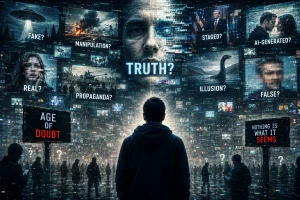
In the Age of Doubt, it begins harmlessly. Videos flood social media that are so obviously fake or absurd that it seems easy to tell what is real and what is not. Or is it?
Even when I was younger, there were videos showing situations so unlikely that they could only happen once in a million. People survived accidents with unbelievable luck, climbing out of completely destroyed cars without so much as a scratch. Today, we would probably assume such footage was fake.
Back then, there were also amusing internet challenges: getting out of a moving car and walking beside it, or climbing buildings without any safety equipment. The challenges of the future may be impossible to imitate, simply because the people performing them are not real.
Or we may begin chasing a beauty ideal we can never achieve. We follow models with impossibly perfect proportions without realizing that they were generated by AI.
The doubts keep growing.
Illusions – Can We Still Trust Deepfakes?
We create an artificial world for ourselves: videos in which we pet unicorns or wrestle the Nemean Lion like Hercules. We wave a magic wand and cast a Patronus charm. We no longer need to grow up, because we can simply live inside our fantasy world.
In that world, we are never overweight and never flawed. We create perfectly beautiful pictures for dating platforms – just like everyone else, of course, even if the first real-life meeting ends in disappointment.
But why meet real people at all if an AI girlfriend finds us completely irresistible?
A deceased family member can be brought back to life in a video and play with us. Then we type the next prompt: “Let the deceased child grow older. Show me what they would have looked like as an adult. Show me their wedding, surrounded by family and friends. Show me the grandchildren who will never exist.”
And why stop there? Why not start a video call with the AI? Answer a few questions, create a personality profile, and then speak with the deceased.
Can something like that really help us come to terms with the past?
Perhaps. But one thing seems certain: it is a market that will be explored sooner or later.
Our Basic Trust Is Crumbling – How AI Manipulation Destroys Trust
These ideas are still little more than experiments. But in the Age of Doubt, no one is truly safe anymore.
Embarrassing voice messages that were never actually recorded. A prank by a co-worker hoping for the next promotion. A friend settling an old score, or simply losing control for a moment. A rejected flirt creates a video showing an alleged affair and sends it to the person’s spouse.
Clearing your name afterwards can be almost impossible – or at the very least, slow and expensive.
What begins harmlessly can gradually erode the basic trust that holds society together.
The AI tools used to create and detect such content are locked in an increasingly rapid race against one another. Public figures are confronted with videos showing them doing things they never actually did. We may no longer know whether Keanu Reeves stroked the dog or kicked it.
But the damage has already been done.
Even though AI can be an extremely powerful and useful tool, its potential for abuse is enormous. Regulation seems almost inevitable, even if there will still be providers on the black market and dark web willing to create videos without watermarks or labels identifying them as fake.
The Good and the Bad – AI-Driven Disinformation and Digital Propaganda
The controversy surrounding a report by the Heute Journal in February 2026 also shows that even reputable sources are not immune to deliberate manipulation. In a report about ICE agents, an AI-generated video was used that did not show a real arrest.
Older footage was also used in a context that supported the narration. It is difficult to avoid the impression that viewers were being emotionally steered in a particular direction.
Especially in wartime, a country can be flooded with fake videos.
Produced months in advance, they may depict the worst kinds of war crimes or show a national leader surrendering.
And all of this before a single shot has even been fired. Propaganda is already intensified by both sides during wartime today, but in the Age of Doubt, everything I consume could potentially have been created by the enemy.
Schrödinger’s Truth – Can We Still Know What Is Real in the Age of AI?
So how will society respond to this spiral of illusions?
Perhaps by slowing down. By stepping outside, spending time in nature, and grounding ourselves again. Our eyes may eventually only be able to trust what they see in the real world.
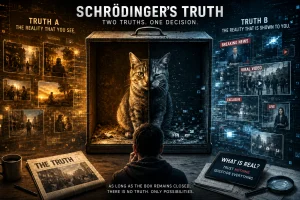
It is a little like Schrödinger’s cat: there are two possible truths, and we may never know which one is correct.
Because the box remains closed.
Ultimately, though, we will probably believe whatever fits within our existing worldview.
In the Age of Doubt, we may have to question everything we consume today.
We will see whether we are mature enough for the leap into the age of AI.
See you in the next one.
Yours,
Ted Dybaer
Did you enjoy the blog?
⭐ Follow me on Instagram & Facebook
☕ If you would like to support my work, you can do so
on BuyMeACoffee, Patreon, or via PayPal
You can discover more stories, worlds, and thoughts here: